Redeker Plan
World War ZThe Redeker Plan is the central emergency doctrine by which governments attempted to survive the Zombie War after ordinary containment had failed. Conceived by Paul Redeker as a solution to an apparently impossible arithmetic—too many civilians, too few soldiers, and an enemy that could not be frightened into retreat—it converts mass abandonment into strategy. The plan preserves a defensible political and military core by sacrificing populations outside it, making survival depend not on saving everyone but on deciding whom the state will protect and whom it will use.
Origins in Apartheid South Africa
The plan began in the early 1980s, when apartheid South Africa faced a convergence of internal revolt, hostile neighbors, the Angolan civil war backed by Cuba and spearheaded by Soviet forces, growing isolation from Western democracies, and an arms embargo. Pretoria had maintained Plan Orange since 1948 as a doomsday contingency for an uprising by the indigenous African majority. As neighboring states gained independence and opposition inside South Africa intensified, the government came to fear that a full confrontation would destroy not only the Afrikaner regime but the Afrikaners themselves.
Paul Redeker was recruited to revise this existing contingency. His 1984 version, known as Orange Eighty-Four, treated survival as a technical calculation involving population figures, terrain, resources, logistics, and the possible use of Cuba’s chemical weapons and South Africa’s nuclear arsenal. Its most consequential innovation was not a weapon but a selection system: Redeker determined which Afrikaners would be saved and which would have to be sacrificed. He assessed income, intelligence, fertility, location, and other qualities that he considered desirable in a surviving population.
The governing principle was that trying to protect everyone would overstrain the state’s resources and doom the entire population, like survivors overcrowding a lifeboat until it capsized. Redeker’s closing formulation placed sentimentality itself outside the logic of survival: “The first casualty of the conflict must be our own sentimentality.” The plan was admired as logical and efficient by powerful officials, but it made Redeker hated by racial ideologues, religious fundamentalists, and, after apartheid, much of the wider South African public. He refused to appear before the Truth and Reconciliation hearings, declaring that he would not pretend to possess a heart merely to save himself.
Adaptation to the Undead Epidemic
During the Great Panic, Redeker was living in an isolated Drakensberg cabin when agents of the National Intelligence Agency broke in. He assumed they had come to kill an apartheid criminal as the world collapsed around them. Instead, the agents lowered their weapons, removed their gas masks, and asked whether he had a plan for the crisis. Redeker had already been working on one as an intellectual exercise, never expecting anyone to read it. Unlike Orange Eighty-Four, it had no name, because he believed names existed only to distinguish one thing from another.
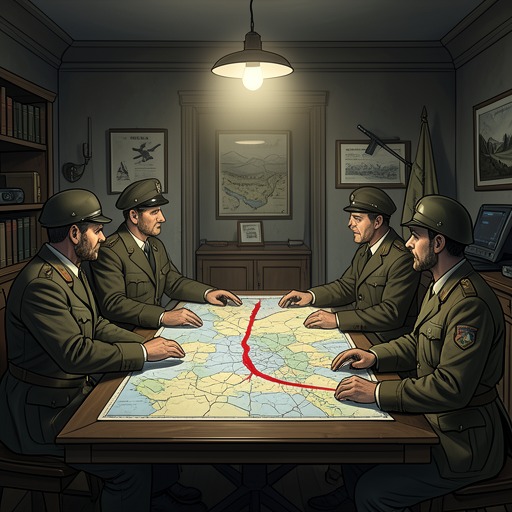
The new plan incorporated the physiology, behavior, and combat doctrine of the living dead. Its first premise was that the outbreak had advanced too far for universal rescue. The armed forces had been weakened beyond their ability to isolate the threat and were scattered so widely that they could only become less effective with each passing day. The military therefore had to consolidate, withdraw to a special safe zone, and use mountains, rivers, or an offshore island as a natural barrier. Once concentrated, the forces could eradicate the infestation within the zone and defend it against further attacks.
This retreat was not presented as an act of panic but as a conventional military withdrawal transformed by the nature of the enemy. General Winter later served a comparable strategic function for Russia: freezing weather bought time to reorganize forces, marshal populations, distribute military hardware, and confront both the western Ural barrier and undead swarms arriving from Asia. The doctrine’s broad appeal lay in its recognition that survival required concentration, preparation, and the conversion of geography and climate into defensive weapons.
The Safe Zone and the Human Bait
The civilian component made the Redeker Plan uniquely disturbing. Only a small fraction of civilians could enter the safe zone. Those selected would provide the labor needed for wartime economic restoration and would preserve the legitimacy of the government by demonstrating to the people already inside that their leaders were still caring for them. Protection was therefore both practical and political: the chosen population would rebuild the state and make its continued authority appear justified.
Everyone else was to be directed into isolated zones and kept there as “human bait.” These refugees were not meant to be abandoned immediately. Redeker argued that they should remain alive, well defended, and, if possible, resupplied, so that the undead would remain fixed around them instead of following the retreating army toward the safe zone. The plan thus transformed civilians into a delaying mechanism. Every undead creature besieging those survivors would, in Redeker’s calculation, be one fewer attacking the defenses.
The moral shock lies in the distinction between neglect and organized preservation for sacrifice. The people outside the safe zone were not merely casualties the government could not reach; they were deliberately maintained as a strategic resource. The agents who confronted Redeker understood the logic and recoiled from it nonetheless. One crossed himself and invoked divine judgment, while another appealed for help. The scene exposes the plan’s governing paradox: its calculations may be rational within a military model, yet their rationality depends on suspending the ordinary claim that each civilian life deserves equal protection.
Implementation and Historical Influence
After the agents extracted Redeker, they flew him to Kimberley, the underground base where he had originally written Orange Eighty-Four. There, the surviving cabinet heard his report, provoking an uproar led by the defense minister. Despite that opposition, the doctrine became the South African Plan and later influenced survival strategies far beyond South Africa. The narrative explicitly identifies Redeker’s work as the basis on which much of the world built its response to the undead.
Its influence is visible in the wartime geography of evacuation and diversion. American refugees were directed north because the government could not feed and screen everyone who might follow the army west behind the Rocky Mountains, nor could it risk allowing the undead to trail such a mass movement. Northern flight offered at least the possibility that winter would freeze the undead and permit some people to survive. Yet the policy was remembered not simply as a necessary diversion but as a failure of communication: vital information was withheld, and the resulting ignorance cost lives.
The plan also illuminates why the war’s early military disasters were so consequential. The Battle of Yonkers shattered public confidence, and its failure of “shock and awe” demonstrated that the undead could not be frightened into surrender. The soldiers’ inability to break the enemy’s spirit allowed the enemy to break theirs. In that context, the Redeker doctrine supplied what conventional battle could not: a method for converting an unafraid, inexhaustible enemy into a force that could be fixed, isolated, and gradually destroyed.
Political and Thematic Significance
The Redeker Plan makes population management the hidden grammar of the postwar world. Refugees are screened, classified, diverted, trained, quarantined, or selected according to their usefulness. At Yeroham, medical personnel examined blood, skin, hair, saliva, urine, and feces before families were cleared for resettlement; in the reconstruction of the United States, more than 65 percent of the civilian workforce was classified as having no valued vocation and was subjected to retraining; Neighborhood Security Teams turned local residents into part-time defenders. These systems differ from Redeker’s bait zones, but they share his assumption that survival depends on sorting bodies according to risk and utility.
The doctrine also clarifies the tension between state protection and state violence. A government may claim to preserve society while excluding large populations from meaningful protection, placing them under military control precisely because they are politically and strategically useful. The resettlement camp, the refugee camp, the safe zone, and the defended bait zone become variations on the same emergency architecture: movement is restricted, information is controlled, and life is preserved selectively rather than universally.
Yet the plan is not presented as an uncomplicated victory. Cuba’s postwar confidence that it “won the Zombie War” stands beside the deprivation and authoritarian isolation that preceded its recovery. South Africa’s broadcasts, later adapted into Radio Free Earth, show a different inheritance from the same crisis: information can protect people where material aid is unavailable. The contrast is crucial. Redeker’s strategy treats knowledge as a tool for deciding who may live; the international broadcast network treats accurate knowledge as a means by which more people might live.
The Redeker Plan endures because it is both effective and morally corrosive. It explains how weakened states could withdraw, consolidate, and preserve the capacity to fight, but it also exposes the price hidden inside every apparently successful retreat. Its deepest question is not whether sacrifice can be justified in an extinction-level emergency. It is who receives the authority to define necessity, who is counted as essential, and whether a civilization saved by turning its own population into bait can still claim to have preserved its humanity.